A Practicum problem: The gulf between the university and the field placement in teacher training
further musings as I work on my findings

Conversations on Mosaic
The next theme in this series focuses on the alignment between the university and the practicum school. Generally, teacher candidates split their time between methodology and broader themed education courses and their practicum. In the two-year program, first-year teacher candidates spend 9 weeks at their home schools, with an additional day per week spent as a link between education theory and practice (p. 19). The second-year students have an eight-week teaching block spanning December and January, as well as an observation week in September. Each teacher candidate is assigned an associate teacher who provides essential feedback and mentoring (Practicum Guide, 2025-26). Discussion groups facilitated by a Faculty Supervisor take place at the university when teacher candidates are not in their home schools. Each Faculty Supervisor has approximately 20 students, and the discussion groups are organized by teaching division: primary/junior, junior/intermediate, and intermediate/senior. The Faculty Supervisor is expected to visit each student in their home school at least once in an academic year. The Practicum Guide also stipulates that the Faculty Supervisor is to maintain “regular contact” (p. 17) with the teacher candidate and the associate teacher throughout the year. There is no expectation that the Faculty Supervisor keep in contact with any other education professor at the university. The details regarding all aspects of the practicum, including an assessment rubric, are contained in the Practicum Guide.
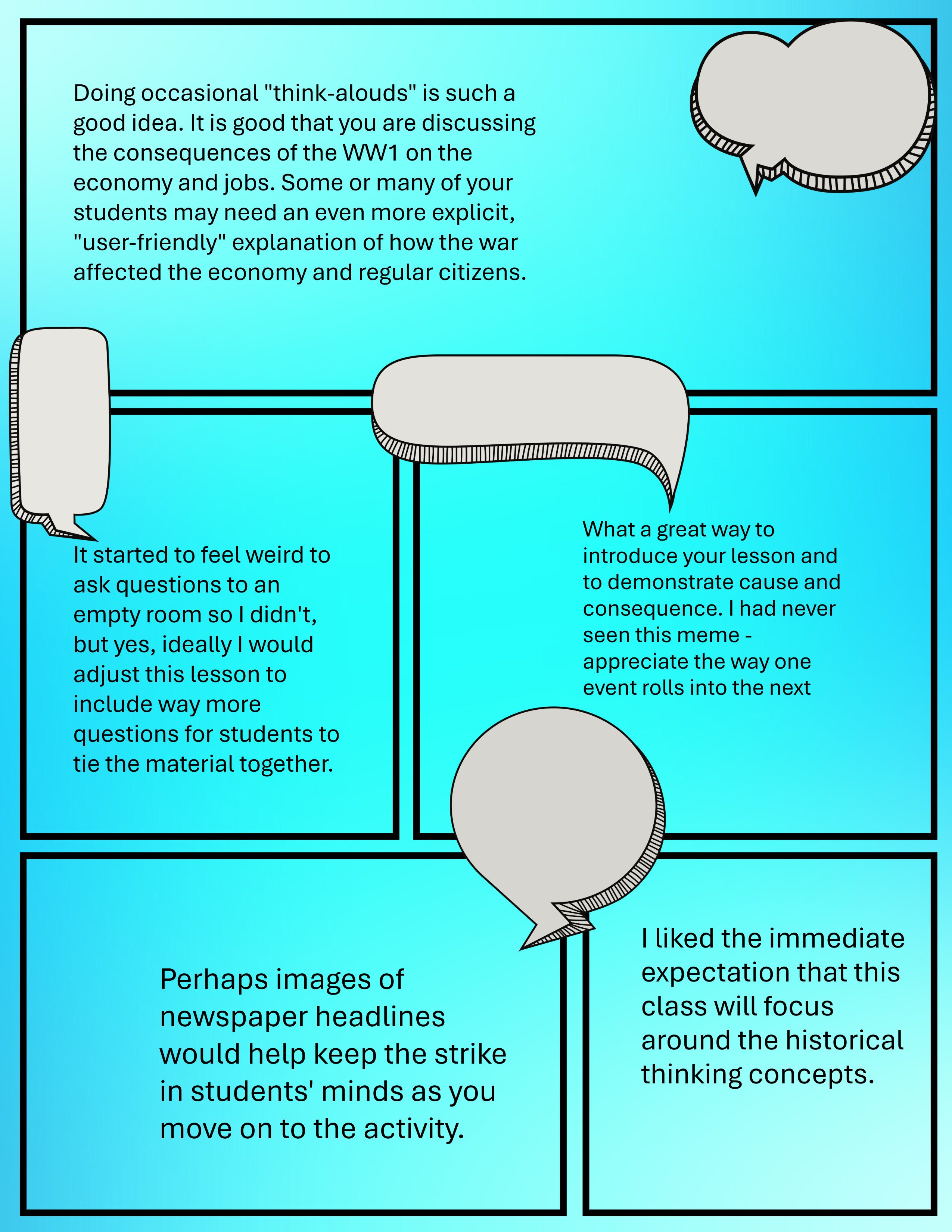
The study conducted with members of the community of practice was not designed to mimic the conditions of a typical practicum. Most importantly, the teacher candidates in the study were not teaching in a classroom. While a live audience of high school students would have been ideal, this was impossible to arrange through the joint school board committee that oversees all research activities in area schools. However, both teacher candidates had completed most of their two-year teacher education program and all of their practicum time. The members of the community of practice, including myself, all had experience either teaching intermediate/senior history classes or conducting practicum discussion groups. Two of the teacher educators have also been associate teachers, working under the same conditions outlined in the Practicum Guide. The teacher candidates were expected to design and teach one history lesson focusing on at least one historical thinking concept: cause and consequence, continuity and change, historical perspective, historical significance, the use of primary historical evidence, and the consideration of the moral dimension in history (Seixas, 2008). Their lessons were filmed and uploaded to a video annotation program, GoReact. Teacher educators were able to watch the uploaded lessons and make time-stamped comments in Mosaic. The collected comments could then be read by all members of the community of practice.
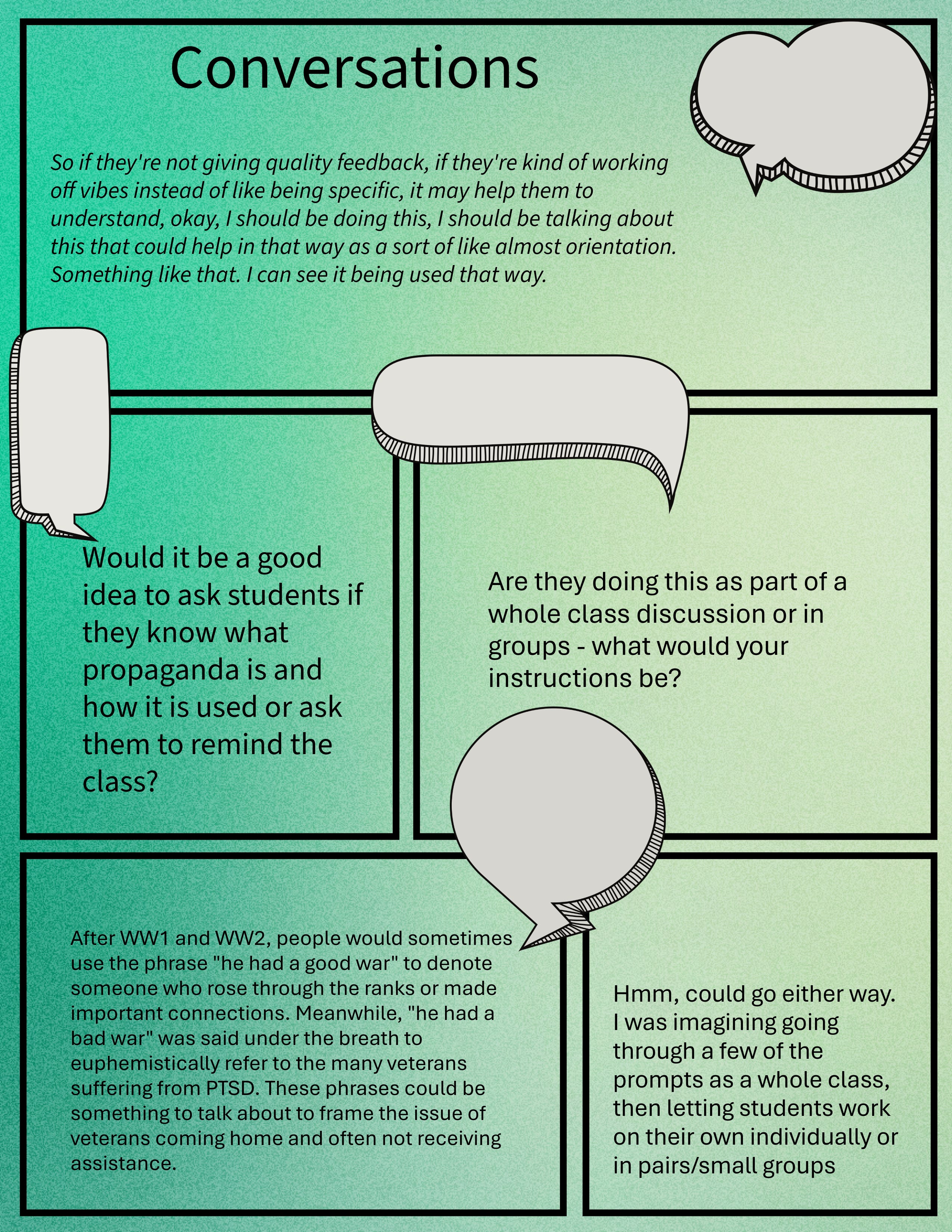
Data collected from these comments, along with transcripts of meetings and interviews with all community of practice members, revealed that the communication channels opened by Mosaic enabled new conversations between teacher educators and candidates that were not available in traditional practicum arrangements. One teacher educator who also acts as a Faculty Supervisor remarked:
I never have an opportunity to talk to an associate teacher, saying, Okay, what’s helpful? Like, what could we do more of? Or what do you need? I mean, not from an administrative, not representing the university, but in terms of being a team, helping somebody learn how to teach.
The disconnection between university methodology teachers and associate teachers was noted as a problem that needed to be addressed. Generally, there is no communication between the teacher candidate, their associate teacher, and their methodology professors, leaving the methodology teacher isolated from the community of practice. Methodology professors involved in the study noted the lack of any contact with the Faculty Supervisors or associate teachers:
I, as a teacher educator, wasn’t able to see what my students were doing in their practicum, and I had no contact with their practicum instructors or their associate teachers. So I only heard what they told me when they came back from practicum.
Using Mosaic as a communication platform for all practicum participants resolved this problem. Participants noted that the quality of feedback using Mosaic enabled more inclusive input, including thoughts from the teacher candidates. One teacher expressed this as communication moving in more than one direction:
I wish we had more opportunities like that because as the teacher candidates were saying, often it’s only one direction. You go into the practica, you’re assessed by your associate teacher, your faculty advisor goes in once or twice. This is so much more rich because you get so many different perspectives.
The main contact between the university and the teacher candidate during practicum is the Faculty Supervisor. This contact, however, is tenuous, and most teacher candidates quickly place greater value on the direction of the associate teacher than on that of university professors (Goldstein et al., 2016). One of the Faculty Supervisors involved in the study expressed what this tenuous relationship looked like:
This is very uneven right now. What happens is that when someone is with an associate teacher, typically a very strong bond forms, especially in the first year, because that is often someone’s first encounter with teaching and this, their associate teacher imprints on them. And so the most important opinion in the room is the associate teachers. Because you’re in that associate teacher’s environment, you know, largely, however open they are, largely according to their rules and the personality and the expectations they set in the classroom. Right now, a faculty supervisor, although who could be incredibly helpful with a candidate on other issues. We’re rather peripheral. We are peripheral in terms of how we feed into the process. In fact, we don’t evaluate at all.
The communication gap between the university and the teacher candidate is a common problem. In the United Kingdom, universities expressed the need for closer communication with teacher candidates during practicum, showing that this concern extends beyond this study. As Rob Caudwell, co-creator of Mosaic notes, “I think, which is why Mosaic, has been so successful in the UK because universities are so desperate to communicate with their students, they’re like, please, we want to stay in touch with you, but you’re in schools all the time”.
The conversations with members of the community of practice follow a common theme. The practicum experience is an essential part of teacher candidate training, and strong bonds form with their associate teachers. However, communication and feedback from university professors and practicum supervisors remain sporadic and disconnected. The community of practice support for building a digital bridge using Mosaic and GoReact shows that participants view these tools as a response to that gap.