Continuing the analysis: Learning through a community of practice
more musings from my data collection

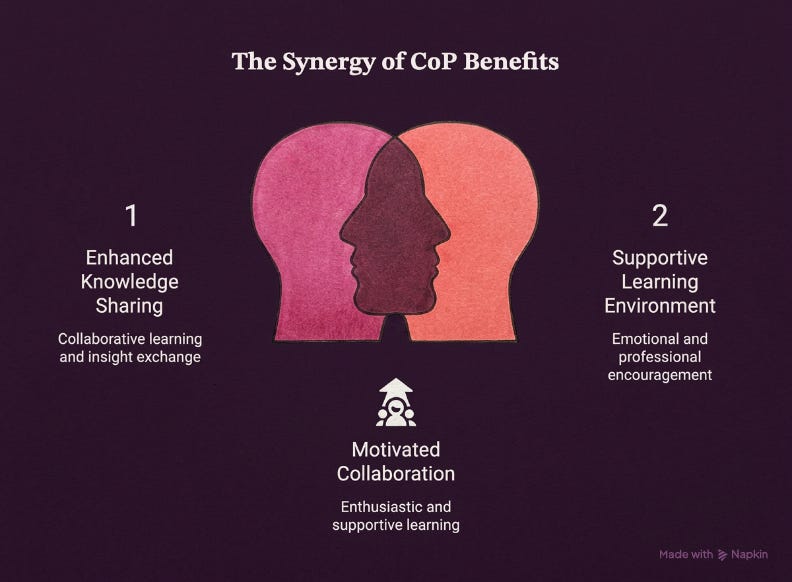
A recurring theme that streams throughout my data touches on the importance of community, specifically, a community of practice. A community of practice is a group of people who gather to engage for a common purpose (Dennen & Burner, 2007). A community of practice sets the stage for learning through a series of steps including modelling, scaffolding of learning tasks, coaching, and reflection referred to as a cognitive apprenticeship approach focusing on the development of metacognitive skills. In this investigation, the community of practice centers on the development of historical thinking teaching skills. Previous studies have shown that instructional strategies based on a cognitive apprenticeship approach can foster the development of students’ historical thinking skills (Wilke et al., 2023). To cultivate this community, I recruited two history teacher candidates in the final year of study, one faculty supervisor, responsible for overseeing the practicum placement for these students, a social studies associate teacher charged with developing teacher candidates through their practicum experience, and two additional teacher educators with a background in publishing, teaching, and supporting history teachers through a provincial association. The teacher candidates had been introduced to historical thinking concepts through two methodology courses at the university and all four teacher educators had taught using historical thinking techniques in their daily practice. Extensive research shows that historical thinking enables K-12 students to interpret past events using discipline specific inquiry skills. It is noted in the literature that the development of these skills can take teachers years to acquire.
The data illustrates that the community of practice approach can facilitate the development of these teaching skills. One teacher educator notes that feedback within the community of practice is substantial providing teacher candidates with meaningful information on their teaching practice in a way they don’t receive in a regular practicum placement, “you’ve given them space to have that trial run so that they can really, again, build that competency and get feedback that is not based on vibes.” Rather, they are receiving comments that are linked directly to their lesson performance while in traditional practice specific feedback is hard to come by:
at the end of the day an associate teacher all they’re able to say is just keep working on your volume, keep working on classroom management for a teacher candidate that may not be very useful…if there is an associate teacher who isn’t giving them like that minute line by line feedback, it can be challenging, to feel like you got really productive feedback.
Participants noted that there was “something missing” from the current practicum learning model. There really was no way for university professors and faculty supervisors to monitor the learning that was taking place during the field practice:
how can a teacher’s teacher properly monitor the progress and breadth of a candidate’s learning and teaching? They need to witness the candidates teaching, hear the candidates reflecting naturally and in response to the teaching (not in required, later reflections), they need to engage in conversations with the candidate about how and why things were done and what happened. This happens, of course, between many candidates and their associate teachers.
The community of practice offers teacher candidates feedback from a variety of professional backgrounds. Teacher educators noted how important this was as a way for teacher candidates to receive an assortment of useful information, “there are so many different people and personalities present, it is important for instructors to recognize how someone else’s personality and experience might benefit from specific insight they have.” Alongside this, the community of practice noted the unique contribution offered through peer to peer feedback. During the follow-up session to the recorded lessons, one teacher candidate thought an important next step would be to view the comments teacher educators made on each of their lessons. Referring to Mosaic, one teacher candidate mused that “it would be cool, I think, if it was more open where we could, as also the students of the education program, be able to learn from each other and comment on each other and be able to like have access to all those sorts of things. Usually, the software was not set up for peer to peer feedback, so we created a work around to facilitate this. A modified version of Mosaic software allowed teacher candidates to see the comments made by teacher educators on each other’s teaching. The modification also allowed them to add comments to each other’s feedback page. For example, one teacher candidate commenting on a lesson on the Winnipeg General Strike suggested, “Great that you mentioned some federal workers joined in solidarity, it helps illustrate that this was not just one factory walkout, but included people across all sorts of industries, even those with job security who were concerned for their compatriots as you mentioned.”
All participants noted that Mosaic, with its capacity to link everyone together as part of an online grouping filled a recognized gap in teacher training. What the community of practice, facilitated by the Mosaic platform provided was a new “home” for discussions on pedagogy. As one teacher educator expressed:
wouldn’t it be much better for all if the faculty supervisor could work in a community of learning with the candidate and associate in a more organic and natural way? Where conversations come from evidence of teaching, and longer and more productive conversations come from a focus on the candidate and where they are in their teaching. The “conversation home” becomes the candidate’s learning and progress, not the faculty classroom or the practicum territory.
Participants agree that what is needed is something that currently does not exist. Teacher candidates and their instructors, both at the university and in the home school need a conversation home where teaching can be viewed in a community of practice, where teacher candidates as part of a learning community draw on feedback grounded in actual evidence. Apart from filling a recognized gap in teacher training, a community of practice facilitated by online learning and networking tools offers an opportunity to enhance the alignment between the university and the local school. Monte-Sano and Budano (2013) demonstrated that close cooperation between the university and the field is critical in developing the pedagogical skills of teacher candidates. In a concluding remark, one teacher candidate sums up the experience, “a lot of the stuff you’ve included is actually pretty like connected to our education. I just wish it was all in one clean place like this.”