Turning Historical Instruction Upside Down: changing the research design
how data collection changes design

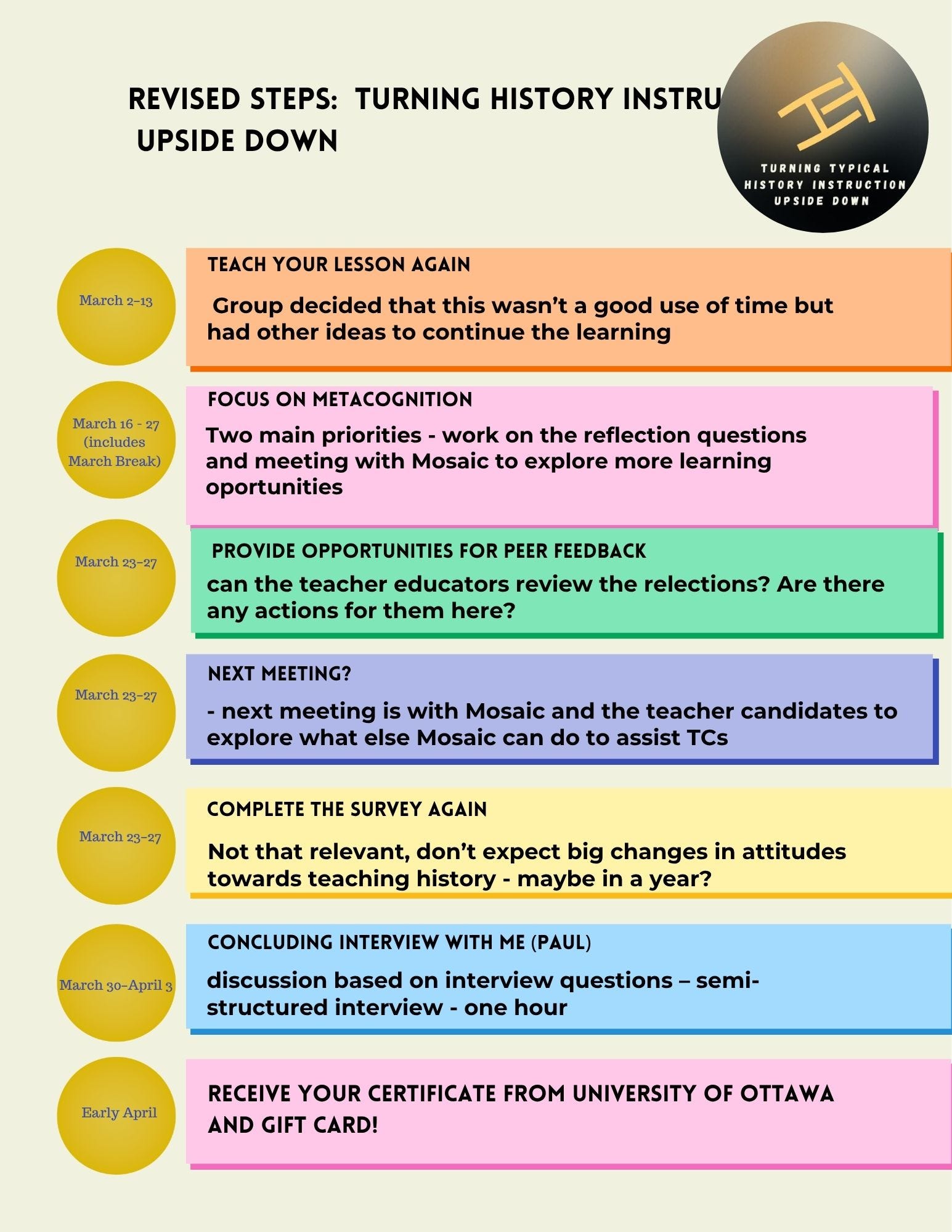
This graphic represents the updated timeline for my dissertation project. It is important for me to document the steps in data gathering, especially as the process changes. I am sure this is the same with most researchers – my original plans shift as I gather more evidence. Originally, the next step in the approach called on the teacher candidates to reteach their original lesson making changes suggested by the teacher educators. One teacher candidate called this a ‘rinse and repeat’ procedure and questioned the value of returning to the lesson.
First, what seems to be important now is the emphasis on metacognition. This is one of the stages in the cognitive apprenticeship process when the learner is encouraged to explain their thought processes and identify areas for improvement. This week, the teacher candidates have been given seven questions to consider as a way to capture their current thinking on the feedback they received from four teacher educators, all with strong pedagogical backgrounds. Here are the seven questions:
1. What did you intend the students to learn about this concept? How well did your instruction and student-centred activities reflect that intention?
2. Why is it important for students to know this? Has teaching this concept — or watching yourself teach cause and consequence — changed or deepened that sense of its importance in any way?
3. What are some difficulties and limitations connected to teaching this concept? You do not need to limit yourself here to the recorded lesson session. How did the comments/observations of the teacher educators inform your understanding of teaching this concept?
4. What teaching procedures did you follow? What are the particular reasons for using these to engage with this concept? Now that you’ve seen the lesson play out — and received feedback — would you make the same decisions again? What, if anything, would you do differently?
5. If this was an actual lesson taught in your class, what ways would you ascertain students’ understanding or confusion around this concept? What evidence would you gather as assessment of learning/for learning and teaching? How would you check for continued and enriched student thinking about this concept?
6. What does this experience tell you about where you are right now as a teacher of history or social studies? What is one thing you want to carry forward, and one thing you want to work on?
7. What did you notice when you watched your recorded lesson or read the feedback from your observers? Was there anything that surprised you, unsettled you, or confirmed something you already suspected about yourself as a teacher?
Each question has been reviewed by the community of practice and each one has been changed to make them more reflective for the teacher candidates. I am hoping that before they answer these questions they will be able to take the time to view and comment on each other’s lesson and feedback. This will add more data and some peer feedback – something that was lacking in the original design. We added the peer feedback because the teacher candidates wanted to get a sense of how the teacher educators commented on the other lesson.
Most of the changes I am now making to the design follow a similar pattern. The teacher candidates have become invested in this process and they are curious how video annotation and the Mosaic platform can work to provide them with deeper learning on their developing pedagogy. We will meet with Mosaic later this week to explore what possibilities exist for going deeper into this process.
As I observe the work of the community of practice, I am not convinced yet that video annotation through Mosaic will be making these teacher candidates more proficient at teaching historical thinking. In other words, my research question - can a process of cognitive apprenticeship within a community of practice, using video-supported analysis, advance the discipline-specific pedagogical content knowledge of pre-service history teachers - may not find an answer based on what I am learning through data collection. While this is surprising to me, this does not seem to be a problem for any of the study participants. Their lesson delivery seems pretty traditional which really is not surprising at this early point in their careers. The teacher educators, some with very strong backgrounds in historical thinking, are not focusing their comments on particular components of Cause and Consequence – the historical thinking concept they are working on. Still, it is evident from the interest and buy-in of the teacher candidates there is valuable learning going on. A dialogue on historical thinking seems secondary to what is being discussed through video annotation. I am hoping the concluding interviews with the participants will give me some sense of what learning is happening and how this is valuable to the teacher candidates.